
A new paper highlights some results from our CSIDE study was recently released in the Journal of Physical Oceangraphy. “Cross-Shore Deformation of a Surfzone-Released Dye Plume by an Internal Tide on the Inner Shelf” led by graduate student Derek Grimes, describes 2015 observations of the fate of a dye plume released in the surfzone as it was deformed by an internal tide on the inner-shelf. While this paper focuses on the detailed dynamics over just a few hours, it highlights the importance of the timing of transport from the surfzone relative to the solar cycle and the internal tide on the ultimate fate of surfzone-sourced material.
Wave interactions with plumes can trap potentially polluted water near shore
Graduate student Angelica Rodriguez just published her research results in Geophysical Research Letters (with co-authors Giddings and Kumar (UW)) and is highlighted in the Scripps news. The paper, “Impacts of Nearshore Wave‐Current Interaction on Transport and Mixing of Small‐Scale Buoyant Plumes” uses idealized modeling of the interaction between small buoyant plumes (e.g., rivers, creeks, storm drains, etc.) and the surfzone to assess their interaction. Under strong waves and/or small outflows, buoyant outflow plumes were effectively trapped close to the coastline, spreading alongshore instead of cross-shore. This has major implications for transport of pollutants that typically accompany freshwater outflows and can hopefully improve beach water quality sampling and management.
The coupling between plumes and waves has been studied before on large scale plumes, but the interaction between smaller plumes and the surfzone – the region where surface gravity waves break near shore – has been investigated here for the first time. Using an idealized model domain representative of the scales of estuaries and plumes common in Southern California, we coupled a hydrodynamic model (ROMS) with a wave model (SWAN) using the COAWST modeling framework. This modeling framework allowed us to look at wave-current interactions and assess the impact of the surfzone on small buoyant outflows. Importantly, we found that vigorous mixing due to waves in the surfzone vertically mixed the buoyant outflow in the surfzone and wave-driven velocities reduced offshore plume propagation, while enhancing alongshore spreading.
Can seagrass help ameliorate ocean acidification?
This important question is addressed in a new paper “Expected limits on the ocean acidification buffering potential of a temperate seagrass meadow,” led by David Koweek at the Department of Global Ecology, Carnegie Institution for Science, Stanford. A press-release from the Carnegie Institution and a blog post by David Koweek do an excellent job summarizing the paper in detail.
This paper is the culmination of an interdisciplinary collaboration amongst seagrass ecologists, chemists, climate scientists, and physicists to address the buffering potential of seagrass meadows against ocean acidification, a critical topic as we face a changing climate. We employed a numerical box model coupled with hydrodynamics and a complex bio-geochemical seagrass/chemistry model to investigate the ability for an estuarine seagrass meadow to buffer the acidity of incoming oceanic water (i.e., to counteract ocean acidification). Overall, buffering capacity was found to be relatively weak, about equivalent to turning back the clock a few decades, which is a small offset to the 150 years of ocean acidification that has already occurred and is worsening. Thus the results suggest that while buffering does occur, it is not enough for long-term ocean acidification mitigation. However, there were brief periods of time when buffering capacity was high; that coupled with new information about how organisms can adapt to changing environments, as well as other potential mitigation approaches, provide potential opportunities to use seagrass as part of a broader strategy to ameliorate local ocean acidification in estuaries. The model for this work was parameterized specifically to Tomales Bay, a northern California large estuary, however the resulting publicly available box-model is designed so that it can be tested under varying conditions.
This work is a contribution of the Seagrass Ocean Acidification Amelioration Workshop of the Bodega Marine Laboratory, financial support for which was provided by California Sea Grant and the Coastal & Marine Sciences Institute of the University of California, Davis. Partial support was provided by the National Science Foundation.
Summer undergraduate projects!
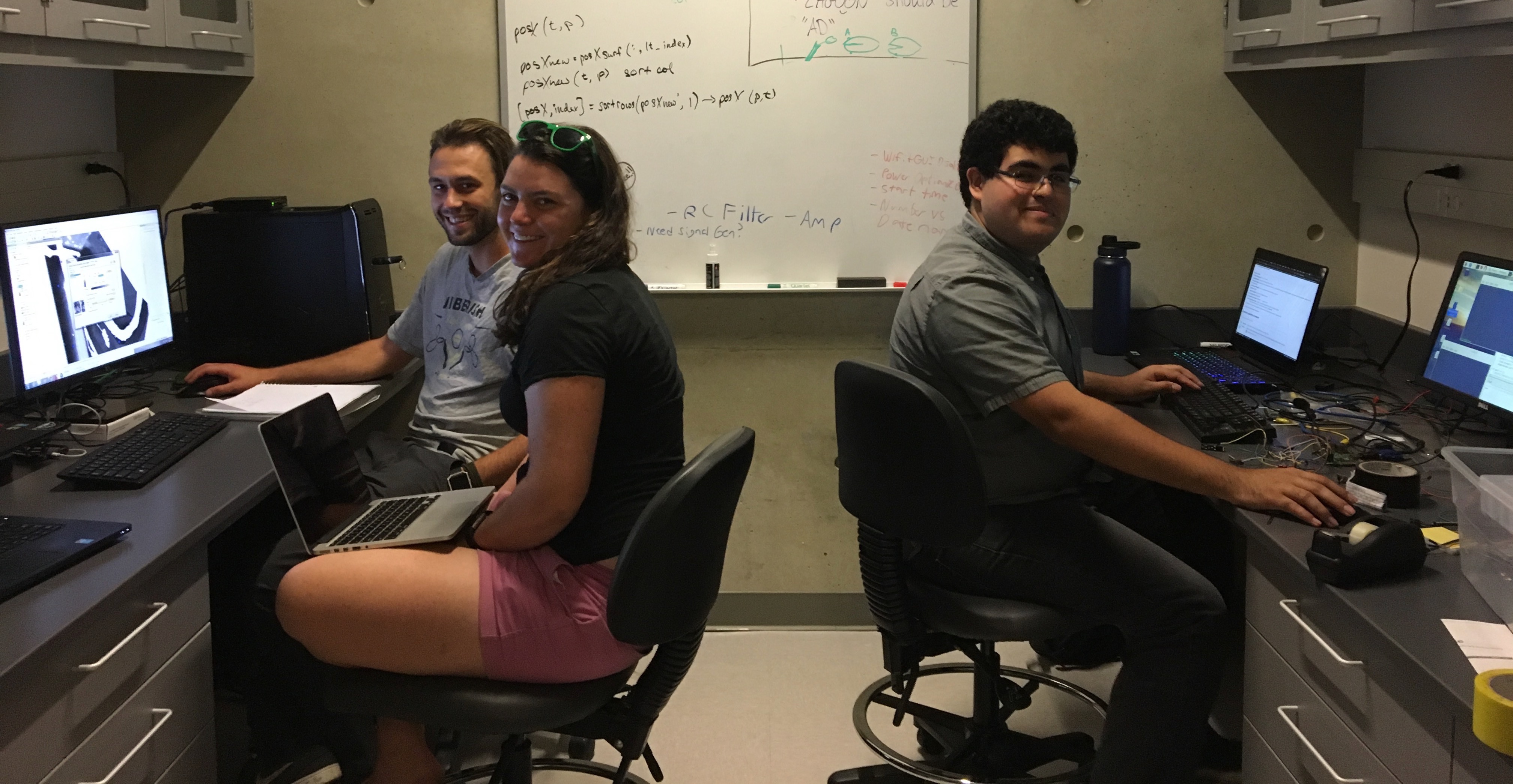
This summer Alex Makic and Adrian Urrea have been working in the lab as undergraduate researchers.
Alex, from Colorado College, majoring in Physics with an Emphasis in Environmental Science, worked for a month in the lab on helping to analyze drone imagery taken above Los Penasquitos Lagoon and adjacent beaches to examine morphological changes over time as part of a California Division of Boating & Waterways funded project. He returns to college in early August, but has already made excellent progress this summer! In addition to working with us, he also worked with Octavio Aburto’s lab assessing Mangrove habitats in Baja California.
Adrian was part of a team of students who worked with Jeff Crooks and I during the 2018 Spring quarter to develop a bio-sensor. Adrian has continued to work in the lab this summer, further developing the sensor which will measure oyster shell gape to study how they respond to surrounding conditions. He is working to improve the sensor, add components (temperature and heart-rate sensors), finalize its calibration, run a field test, and build more of them!
Workshop on the future of coastal and estuarine modeling
18 – 21 June 2018, Giddings attended and presented at the NSF sponsored Workshop on the future of coastal and estuarine modeling. Presentations ranged from numerical discretization schemes, to nonhydrostatic versus hydrostatic code, to the state of the art in wave model-hydrodynamic model coupling. It was a very interesting several days discussing where we are in coastal and estuarine modeling and what are the major hurdles as well as opportunities ahead.
Border 2020 stakeholder kickoff meeting
13 June 2018 – The EPA hosted a kickoff meeting for two new Border 2020 funded projects aiming to reduce coastal water pollution along the US/Mexico Pacific border. Falk Feddersen and Sarah Giddings presented an introduction to their recently funded Border 2020 Border Environment Cooperation Commission (BECC) project entitled: “Evaluating the 2017 Tijuana River Estuary cross-border wastewater spill sources and coastal impacts.” This work builds off of modeling work started during the CSIDE project, but is heavily focused on the applied aspects of this research, specifically understanding the sources and impacts from a particularly large spill that resulted in extended beach closures in early 2017. We got great feedback from stakeholders (government agencies, public, other research groups, nonprofits, etc.) and also heard more about a complimentary observational project SCCWRP is leading under the same grant program.
MAS in Marine Biodiversity and Conservation Annual Capstone Symposium
12 June 2018, Students completing the Master of Advanced Studies in Marine Biodiversity and Conservation presented their capstone projects at the Annual Capstone Symposium. Kelsey Miller, who Giddings has been working with over the Winter and Spring quarters 2018, presented her project: Tribal Intertidal Digital Ecological Survey (TIDES) Project: A Conservation Technology Partnership with Coastal Indigenous Nations Advisors: Dr. Jennifer E. Smith (Chair), Scripps Institution of Oceanography; Dr. Sarah N. Giddings, Scripps Institution of Oceanography; Megan Van Pelt, Natural Resources Department, Tolowa Dee-ni’ Nation; Clinton B. Edwards, Scripps Institution of Oceanography. Kelsey did an amazing job with the work and the presentation.
lab get-together
Forgot to take pictures, but we all went out to lunch as a lab to welcome Alma Castillo Trujillo for a short visit who will be joining the lab in September 2018 as a postdoc. Great to have such a wonderful group of people!!
Oyster biosensors!!
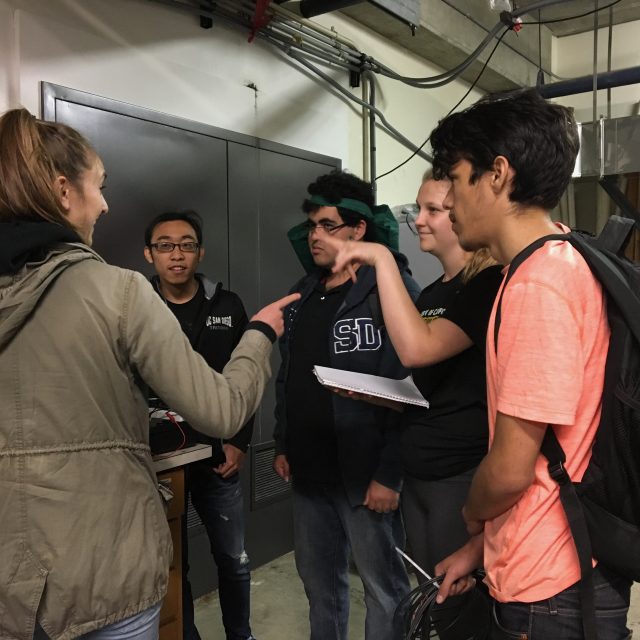
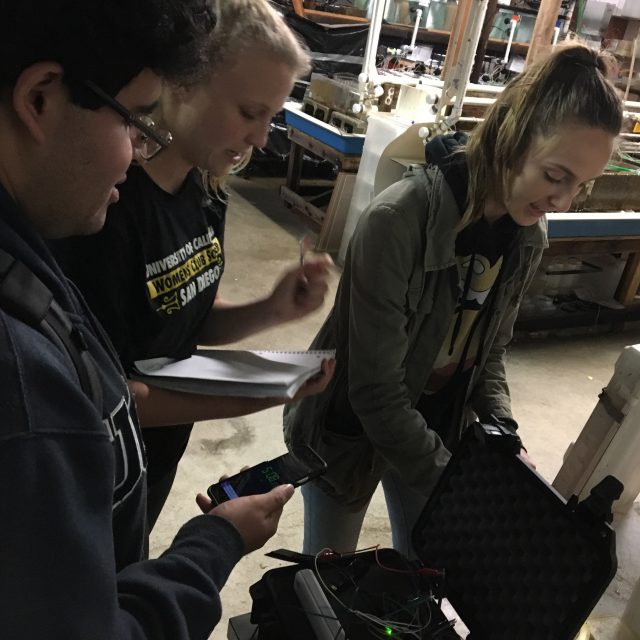
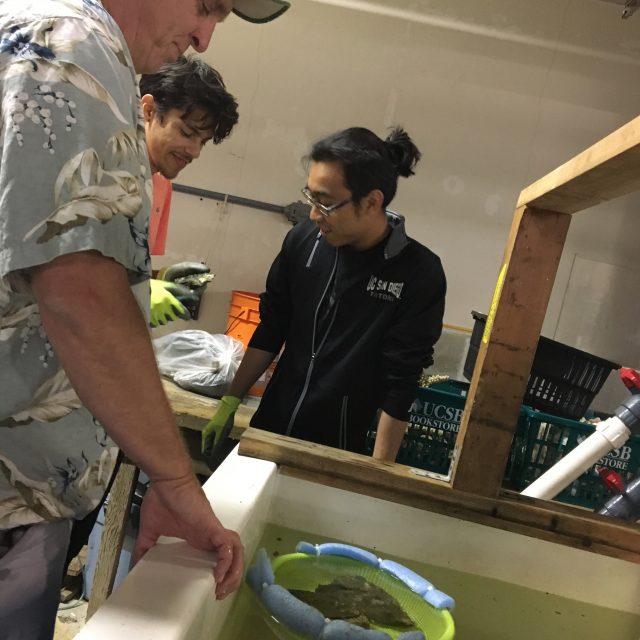
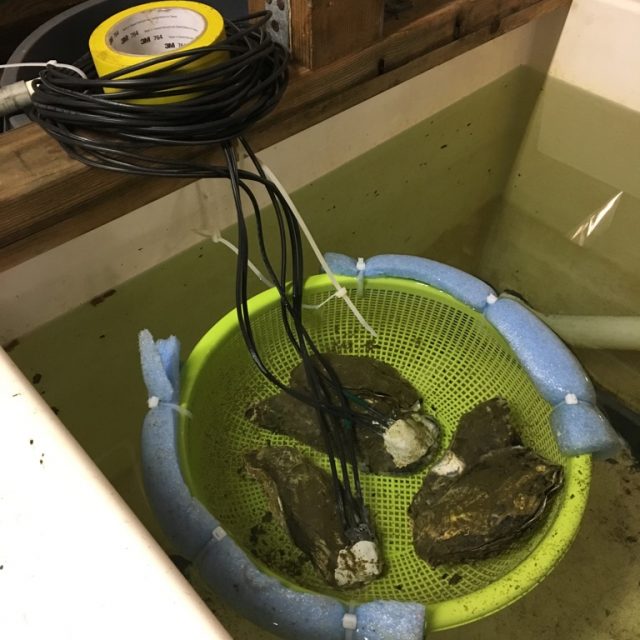
For their senior design course in Mechanical & Aerospace Engineering (MAE126b) a group of undergraduates decided to work with Dr. Jeff Crooks (Tijuana National Estuarine Research Reserve Research Coordinator) and Dr. Sarah Giddings to design biosensors for oysters. During just one quarter, team members Adrian Urrea, Hsing-Han (Hans) Chung, Emma Schoenthal, Claudio Coleman, and Marika Hale successfully built a prototype that can measure the shell gape of an oyster!! Photos of their test deployments in the SIO seawater facility (thanks to Phil Zerofski, facility manager) and a link to their project website are here:
-

- the team debating how to set up the oyster in the SIO seawater facility
-

- sensor calibration
-

- Jeff Crooks advising the team
-

- checking the output

-

- bucket tests first

-

- oysters being monitored!
Tijuana Estuary Tidal Restoration Program meeting
16 May 2018 – Tijuana Estuary Tidal Restoration Program (TETRP) meeting. TETRP is a multi-phased restoration for the Tijuana River aimed at restoring habitat through projects such as those aimed to increased tidal flushing. TETRP has already completed two major restorations and Giddings is a science advisor for the most recent phase of the program.